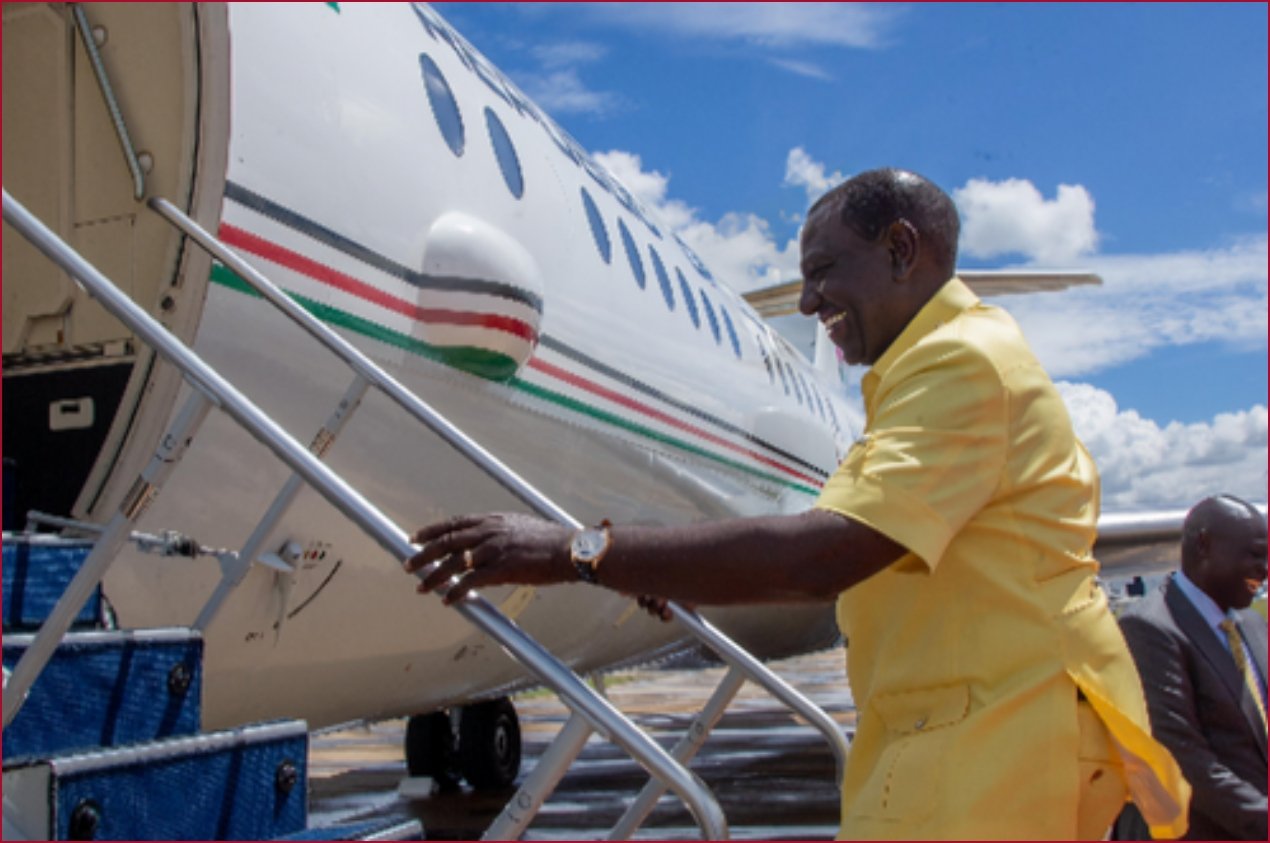
President William Ruto departed for Luanda, Angola, on Monday for two high-level engagements focusing on Africa-Europe cooperation and reforms within the African Union.
He will attend the 7th African Union–European Union Summit and later co-chair the Second Session of the Ad Hoc Oversight Committee on African Union Institutional Reform.
According to State House, President Ruto will chair the reform committee in his role as the AU Champion for Institutional Reform.
His visit comes at a time when global geopolitical shifts, funding pressures, and security concerns continue to test Africa’s partnerships and internal governance systems.
At the AU-EU Summit, President Ruto and other leaders will examine two decades of cooperation between the continents.
The discussions will centre on emerging challenges, including new geopolitical priorities, widening funding gaps, and increasing security threats.
Kenya is expected to push for predictable financing for African-led peace operations and stronger counter-terrorism cooperation.
Climate action will also feature prominently, with the President expected to support calls for joint AU–EU initiatives aimed at bolstering resilience and sustainable development across the continent.
State House noted that President Ruto will hold bilateral talks with several European leaders. These discussions will focus on expanding trade, unlocking new investment, and advancing the Kenya–EU Economic Partnership Agreement.
Kenya plans to highlight opportunities under its economic transformation roadmap, which targets the country’s transition to a first-world economy.
The President will showcase a pipeline of public-private-partnership-ready projects, including large-scale irrigation supported by mega dams, expansion of clean and industrial energy, and major road, airport, port, and railway upgrades.
These infrastructure and energy projects form a significant part of Kenya’s broader strategy to attract foreign capital and accelerate economic growth.
Following the AU-EU Summit, President Ruto will co-chair the AU Institutional Reform Ad Hoc Committee of Heads of State.
He will brief fellow leaders on progress in implementing reform mandates aimed at strengthening governance, peace and security mechanisms, and financial independence within the African Union.
The AU reform agenda seeks to make the continental body more efficient, self-reliant, and responsive to emerging global challenges.
Key areas of focus include improving decision-making processes, enhancing administrative capacity, and increasing transparency in AU operations.
State House said the overall package of reforms is designed to reinforce African unity and strengthen the continent’s ability to respond quickly and decisively in a shifting global environment.
The meetings in Luanda are expected to shape future cooperation frameworks between Africa and Europe while setting the direction for the next phase of AU institutional modernization.































Comments
Sign in with Google to comment, reply, and like comments.
Continue with Google